Table of Contents
Overview
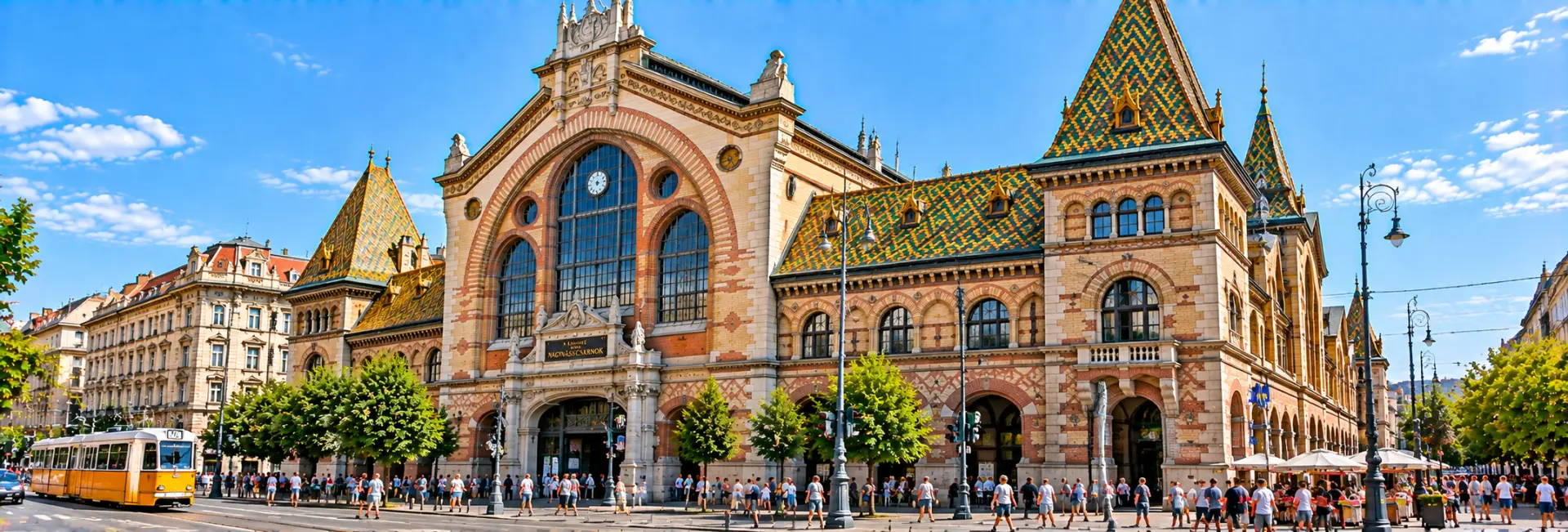
The Central Market Hall, known locally as Nagyvásárcsarnok, is Budapest's largest and oldest covered market, standing on the Pest bank of the Danube at the foot of Liberty Bridge. Opened in 1897, its steel-framed hall and tiled roof have made it one of the city's most recognizable buildings, as well as a working marketplace that locals still rely on for fresh food.
Spread across three levels, the hall combines the bustle of a produce market with the pull of a major tourist attraction, drawing shoppers hunting for paprika and Tokaji wine alongside visitors looking for a quick lángos or a souvenir to take home. Few buildings in Budapest manage to serve both roles as naturally as this one does.
Its location is part of the appeal. Sitting directly at the Pest end of Liberty Bridge and at the southern tip of Váci utca, the hall functions as a natural gateway between the city's main pedestrian shopping street and the riverside walk toward Gellért Hill, so a stop here fits easily into a longer day of sightseeing rather than requiring a special trip.
History
Origins and Construction
The idea for a large, purpose-built market hall came from Károly Kamermayer, Budapest's first mayor, who wanted the newly unified city to have a marketplace on par with those he had admired in Paris and London. After years of debate over financing and location, the city's general assembly approved the project in 1891, and architect Samu Pecz was chosen to design it.
Construction began in 1894 on a plot beside the river, chosen so that barges could unload produce directly at the building. A fire shortly before the planned 1896 opening destroyed part of the roof and delayed completion, pushing the official opening to 15 February 1897, an event Kamermayer, by then retired, still attended as a private citizen rather than as mayor.
Early Years
From its opening, the hall was built around the idea of quality control, requiring that food sold on its floors be inspected before reaching customers, a novelty for Budapest at the time and part of the broader push toward modern public sanitation that Kamermayer championed throughout his career. Goods arrived by rail and by barge through the market's own loading channels, and the wide central aisle was sized specifically to let heavy delivery carts pass through with ease.
The market quickly became a fixture of daily life in the city, and Budapest's writers of the era took note of its energy and variety, with the market hall becoming a fixed point of reference in descriptions of the capital's street life during the early 20th century. It was one of five large covered markets built around the same period to modernize food distribution across the newly unified city, but its size and central riverside location meant it quickly overshadowed the others in both trade volume and public affection.
Damage, Decline, and Restoration
The building suffered significant damage during the Second World War, and postwar repairs were done quickly and without matching the quality of the original construction. Conditions worsened over subsequent decades under limited maintenance budgets, and by 1991 the hall was judged structurally unsafe and closed to the public, leaving one of the city's best-known buildings dark and empty for several years.
A large-scale restoration through the 1990s rebuilt the structure and its decorative details, including a new set of colorful roof tiles, and the market reopened in 1997. The renovation was later recognized with the FIABCI Prix d'Excellence, one of international real estate's most prestigious awards, in 1999, cementing the hall's return as both a working market and a piece of restored heritage architecture.
Architecture & Design
Exterior
The building blends Neo-Gothic and Neo-Renaissance elements, with a red-brick façade and an entrance gate whose pointed arches give it a distinctly church-like silhouette. Its roof is covered in glazed Zsolnay tiles from the city of Pécs, arranged in bands of color that make the hall easy to pick out from elsewhere in the city.
Interior
Inside, an iron-and-steel frame supports a soaring, light-filled hall roughly 10,000 square meters in area, a scale that was unusual for a market building of its era. A wide central aisle, originally built to accommodate loaded delivery carts, still runs the length of the ground floor and now serves as the main path for shoppers moving between stalls.
- Three distinct levels: a basement, a ground floor, and an upper mezzanine
- Exposed iron trusses and columns supporting the roof structure
- A patterned brick and tile exterior visible from Liberty Bridge and the surrounding streets
- Large arched windows that flood the hall with natural light
The neo-Gothic entrance gates, with their pointed arches and detailed brickwork, were designed to make an impression before shoppers ever reached the stalls inside, turning the act of entering a marketplace into something closer to entering a civic monument.
Recognition / Status
The Central Market Hall has been a listed historic building since 1977, formally protecting its structure and façade. Its 1990s restoration earned the FIABCI Prix d'Excellence award in 1999, a mark of recognition within international architecture and real estate circles.
The hall's reputation has grown well beyond Hungary: in 2013, CNN named it one of the best market halls in Europe, a distinction frequently repeated in international travel coverage and one that has helped cement its place on most visitors' Budapest itineraries. That combination of protected status and popular acclaim is part of why the building continues to draw both preservation-minded architecture visitors and shoppers with no particular interest in history at all.
Market Floors & What's Inside
Roughly 180 stalls and small shops fill the hall's three levels, each with its own character and mix of goods. The layout still loosely follows the original logic of the building, with heavier, less glamorous goods kept toward the basement and lighter, more visitor-facing offerings occupying the upper floor.
Ground Floor
- Fresh fruit and vegetables, often arranged in colorful, photogenic displays
- Hungarian paprika in many grades and forms, from ground spice to strings of dried peppers
- Salami, sausages, and other cured meats
- Tokaji and other Hungarian wines, along with local spirits
Basement
- Fishmongers and game meat vendors
- Pickled vegetables, including cucumbers, cabbage, and peppers
- A small supermarket for everyday grocery items
Upper Floor
- Food stalls serving Hungarian dishes such as goulash and lángos
- Stands selling embroidery, linens, and other traditional crafts
- Souvenir vendors offering everything from magnets to folk art
Because the upper floor sits above the main hall rather than enclosed within it, its food stalls and craft stands benefit from views down over the ground-floor bustle, making it a popular spot to pause with a plate of food before continuing to shop.
Ways to Experience It
The most straightforward way to experience the hall is simply to walk its floors, browsing stalls and sampling food as you go. For a deeper introduction, several tour operators run guided market tours and tastings that walk visitors through the building's history while pointing out the best vendors for specific products.
- Browse the ground floor for ingredients to take home, from paprika to bottled wine
- Eat lunch at the upper-floor food stalls for a casual sampling of Hungarian dishes
- Join a guided food tour or tasting for context and recommendations from a local guide
- Combine a visit with a cooking class, since several Budapest cooking schools shop for ingredients here before class
Because the hall is compact and fully indoors, it also works well as a rainy-day activity or a midday break from walking tours of the surrounding neighborhood.
Best Time to Visit
The market is open every day except Sunday, with the earliest and freshest selection available right at the 6am opening. Weekday afternoons tend to be the quietest time to browse, while Saturday mornings, especially from around 9am, draw the largest crowds of both locals and tourists.
Visitors hoping to eat at the upper-floor food stalls do best arriving just before midday, when the kitchens are in full swing but the lunchtime rush has not yet claimed all the seating.
Visitor Tips
- Bring cash, as many smaller stalls do not accept cards
- Prices can run higher at stalls near the main entrance; walking further into the hall or to the basement often turns up better value
- Set aside at least an hour to explore properly, more if you plan to eat or shop for souvenirs
- Restrooms are available on the upper floor for a small fee
- The building is wheelchair and stroller accessible, with elevator access between floors
- Keep an eye on belongings in busy areas, as with any crowded tourist attraction
- Sampling a small amount before committing to a large purchase of spices or sweets is generally welcomed by stallholders
Nearby Attractions
The Central Market Hall sits at the southern end of Váci utca, Budapest's best-known pedestrian shopping street, and right at the Pest foot of Liberty Bridge.
- Váci utca, a pedestrian street lined with shops, cafés, and restaurants
- Liberty Bridge, an easy walk across the Danube toward Buda
- Gellért Hill and the Gellért Baths, reachable on foot across Liberty Bridge
- Fővám tér, the square outside the market and a stop on metro line M4
- Kálvin tér, a short walk away with a connection to metro line M3
FAQs about visiting the Central Market Hall
What is the Central Market Hall known for? +
It is Budapest's largest and oldest indoor market, known for its striking Neo-Gothic and Neo-Renaissance building, colorful Zsolnay-tiled roof, and three floors of Hungarian food, produce, and crafts.
When is the best time to visit? +
Weekday afternoons are the quietest, while Saturday mornings from around 9am draw the biggest crowds; arriving near opening at 6am gives the best pick of fresh produce, and just before midday is ideal for lunch at the food stalls.
How much time should I plan for a visit? +
Plan at least an hour to browse all three floors, and longer if you want to eat lunch or shop unhurried for souvenirs and gifts.
Is the market open every day? +
No, it is open Monday through Saturday and closed on Sundays, with shorter hours on Mondays and Saturdays than during the rest of the week.
Do I need cash, or can I pay by card? +
It's best to carry some cash, since many of the smaller stalls, especially in the basement and upper floor, do not accept card payments.
Is the Central Market Hall suitable for children or visitors with mobility needs? +
Yes, the building is wheelchair and stroller accessible with elevator access between floors, and the lively market atmosphere tends to appeal to children as well as adults.
What can I buy there? +
Typical purchases include paprika, Tokaji wine, salami and cured meats, pickled vegetables, embroidered linens, and souvenirs, alongside prepared Hungarian food from the upper-floor stalls.
Is it touristy, or do locals still shop there? +
Both: the ground floor and basement remain genuine grocery destinations for local shoppers, while the upper floor leans more toward tourists with its food stalls and souvenir stands.
What's nearby to combine with a visit? +
Váci utca's shopping street, Liberty Bridge, and the Gellért Baths across the river are all within easy walking distance of the market.