
Table of Contents
Overview
The Kunstkamera is the museum that Peter the Great founded in 1714, and it is generally regarded as the oldest museum in Russia. Its name comes from the German word for a chamber of curiosities, and the idea behind it was to gather the wonders of nature and human skill in one place so that people could study and learn from them.
Today the museum is formally the Peter the Great Museum of Anthropology and Ethnography, part of the Russian Academy of Sciences. It keeps well over a million objects and is both a public museum and an active research institution. Visitors come for its ethnographic halls, which cover peoples and cultures from around the world, as well as for the old cabinet of curiosities that gave the museum its fame.
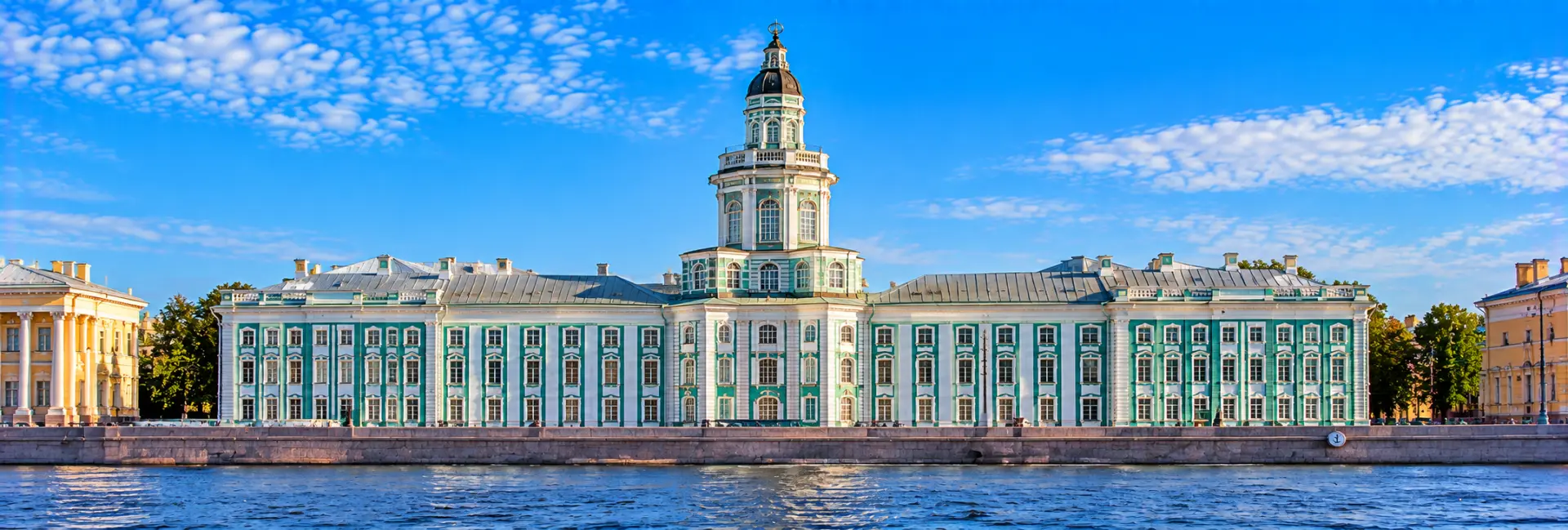
The setting adds to the appeal. The Kunstkamera stands on the Universitetskaya Embankment of Vasilievsky Island, with its distinctive tower facing the Neva and the Winter Palace on the opposite bank. It is an unusual, thought-provoking stop, quite different from the city's palaces and art galleries.
History of the Museum
A Tsar's Cabinet of Curiosities
After traveling through Western Europe in the late 1690s, Peter the Great became fascinated by the cabinets of natural and artistic rarities kept by scholars and collectors. He began assembling his own collection, and in 1714 it was opened to visitors in the Summer Palace, which the museum treats as its founding date. Peter was especially interested in natural objects and in encouraging scientific study rather than superstition.
Great Purchases from the Netherlands
The collection grew rapidly through the purchase of whole collections from the Netherlands. Major acquisitions included the natural history cabinet of the apothecary Albertus Seba in 1716 and the anatomical preparations of Frederik Ruysch in 1717. They were soon too large for the Summer Palace, which led Peter to commission a purpose-built home.
Home of the Academy of Sciences
In 1724 the Kunstkamera became part of the newly founded Academy of Sciences, and for a long time the building housed the Academy's library, observatory and scientific work as well as the museum. The polymath Mikhail Lomonosov lived and worked in the building from 1741 to 1765, and part of the museum is devoted to him.
From Curiosities to Anthropology
In the nineteenth century the original collections were gradually divided among new museums. In 1879 the ethnographic and anatomical holdings were merged to form the Museum of Anthropology and Ethnography, which took Peter the Great's name in 1903. The museum has kept the old name Kunstkamera for its historic building and for its heritage.
Architecture & Building
A Petrine Baroque Landmark
The original building is a fine surviving example of Petrine Baroque, the early eighteenth-century style of Peter's new capital. It was designed by the architect Georg Johann Mattarnovy, with the foundation laid in 1719 and construction largely completed by 1727. Several other architects, including Mikhail Zemtsov, finished the decoration, and the museum opened to the public in 1728. It is considered the first building in Russia designed specially as a museum and is one of the oldest purpose-built museums in the world.
The Tower
The building has two long wings, one for the collections and one for the library, joined by a tall central tower. The tower once held an anatomical theatre, a room for the great Gottorp Globe and an astronomical observatory. At its top sits an armillary sphere, a skeleton model of the heavens that has become one of the building's trademarks.
A Story About a Pine Tree
The museum tells a story that Peter chose the site after noticing an unusual pine tree growing there and ordering the building to be put up where it stood. A section of that trunk is said to be kept in the museum. Whatever the truth behind the tale, the location on the tip of Vasilievsky Island was chosen as part of Peter's plan for a scientific and cultural center beside the Neva.
Fire, Repair and Expansion
A serious fire in 1747 destroyed some collections and damaged the building, and it was subsequently rebuilt and redecorated. A further wing facing Tamozhenny Lane was added in 1887, and today the museum occupies both the old and the newer buildings.
Collections & Exhibits
The museum's holdings fall into two broad groups: the historic collections assembled in Peter's era, and the ethnographic, anthropological and archaeological collections that were built up over the following centuries. Together they represent more than a million objects.
Ethnography of the World
Much of the museum is devoted to the cultures of the peoples of the Old and New Worlds. Halls cover regions such as North America, the Pacific, Asia, Africa and Siberia, and display clothing, tools, ceremonial objects, models and everyday items. Some of the oldest pieces were brought back by Russian scientific expeditions and voyages of exploration, and there are items connected to the voyages of Captain James Cook.
Collections from Expeditions
- Siberian collections gathered during expeditions by scholars of the Academy of Sciences
- Material from Russian circumnavigations and research in the Pacific
- Early Japanese objects and items from Asia
- Items from the voyages of James Cook
The Historic Cabinet of Curiosities
The most famous and most unusual part of the museum is the display of anatomical and natural specimens from Peter's collection, including preparations by Frederik Ruysch. Peter collected such material for scientific reasons, hoping to understand and dispel fears about birth defects and natural anomalies. The display includes human and animal specimens, which some visitors find disturbing, so it is worth being prepared before you go in.
Must-See Highlights
The Gottorp Globe
The museum's largest and most celebrated exhibit is the Gottorp Globe, a giant globe about 3.1 meters across. It was made in the 1650s and 1660s for the Duke of Holstein-Gottorp and given to Peter the Great during the Great Northern War, arriving in Saint Petersburg in 1717. It works as an early planetarium: a map of the earth is on the outside, and a map of the stars lies within, and the two can rotate together. The globe is on display in the tower, and visits to it are by guided tour only.
The First Astronomical Observatory
The tower also houses an exhibition on the building's role as an early observatory, where astronomical, geographical and map-making work began in Russia. Observations continued here until the Pulkovo Observatory was completed in 1839.
The Lomonosov Museum
A section of the museum is dedicated to Mikhail Lomonosov, with personal belongings, mosaic portraits from his workshop, scientific instruments and books, and a look at the early years of the Academy of Sciences. It gives context to the intellectual life of eighteenth-century Saint Petersburg.
The Old Cabinet and the Building Itself
Take time to look at the historic halls, the display on the museum's own history and the architecture of the tower. The exhibition about the Kunstkamera building has value in its own right and helps explain how the idea of a museum itself developed in Russia.
Ways to Experience It
Independent Visits
Most visitors tour the main ethnographic and historical halls on their own. The museum offers a mobile guide and a virtual 3D tour on its website, which can help you decide which areas to focus on before you arrive.
Guided Tours
Guided tours are available for groups, and they are required for entry to the Gottorp Globe and the observatory exhibition. Group tours can be booked in advance with the museum, and anyone who books a guided group tour does not need to buy a separate general admission ticket.
Other Options
- Temporary exhibitions that focus on particular peoples, regions or themes
- Free admission on the third Thursday of each month from September to April
- Browsing the collections online through the museum's database
Best Time to Visit
Season
The Kunstkamera is an indoor museum, so it is suitable at any time of year. It makes a good choice for a cold or rainy day, and in summer it can be paired with a walk along the Neva embankment and the Spit of Vasilievsky Island.
Day and Time
The museum has typically been open from Tuesday to Sunday, with the last entry an hour before closing. It has been closed on Mondays, on the last Tuesday of each month and on a few public holidays, so check the calendar before you go. Mornings and weekdays tend to be calmer, and free-admission days can be busier.
Allowing Enough Time
Plan on two hours or so for a general visit, and longer if you want to explore the ethnographic halls in detail or join a guided tour of the globe and tower.
Visitor Tips
- Check opening hours, closing days and admission details on the museum's official website, as they change and are not fixed here
- Be aware that the historic cabinet displays human and animal specimens, which may be upsetting for some visitors and may not suit young children
- Book a guided tour in advance if you want to see the Gottorp Globe, since it can only be visited with a guide
- Check the museum's rules on photography and filming before you arrive
- Wear comfortable shoes, as the visit involves stairs and a good deal of walking
- Contact the museum ahead of time to ask about accessibility, since the historic building has stairs and several levels
- Confirm current travel advisories from your own government and how payments and ticket booking work for foreign visitors, as arrangements for international travelers to Russia can change
The museum is on Vasilievsky Island, directly across the Neva from the Admiralty and the Winter Palace, and is reached on foot over the Palace Bridge or by public transport from the nearest metro stations.
Nearby Attractions
The Kunstkamera sits at the heart of one of the city's most historic districts, so you can easily build a full day around it.
- Spit of Vasilievsky Island and the Rostral Columns: a scenic point with panoramic views of the Neva and the city skyline
- Menshikov Palace: one of the earliest stone palaces in Saint Petersburg, further along the embankment
- The Twelve Collegia: the long building that now serves as part of Saint Petersburg State University
- Academy of Arts and the Sphinxes: a landmark on the embankment with two ancient Egyptian statues
- Palace Bridge: the main crossing to the Admiralty and the Winter Palace
- The Hermitage: directly across the river, a short walk away
FAQs about visiting the Kunstkamera
What is the Kunstkamera? +
It is the Peter the Great Museum of Anthropology and Ethnography, established by Peter the Great in 1714 as Russia's first museum. It displays a historic cabinet of curiosities alongside extensive ethnographic collections from around the world.
Where is the Kunstkamera located? +
It is at 3 Universitetskaya Embankment on Vasilievsky Island in Saint Petersburg, facing the Neva and the Winter Palace.
What is the Gottorp Globe? +
It is a huge globe, about 3.1 meters in diameter, made in the seventeenth century in Gottorp. A planetarium of the stars is inside it. It was given to Peter the Great and is on display in the Kunstkamera tower.
Can I see the Gottorp Globe on my own? +
No. Entry to the exhibitions about the globe and the first astronomical observatory is by guided tour only, so you need to arrange a tour in advance.
Is the Kunstkamera suitable for children? +
Parts of it, such as the ethnographic halls, are suitable for many children, but the historic cabinet of curiosities includes human and animal specimens that some find disturbing. Parents may want to look at the displays first and decide.
How long should I allow for a visit? +
Allow around two hours for a general visit, longer if you want to join a guided tour or explore the ethnographic halls in depth.
When is the museum open? +
It has typically been open Tuesday to Sunday, and closed on Mondays, on the last Tuesday of each month and on some public holidays. Check the official website for current hours.
Is admission ever free? +
The museum has offered free admission on the third Thursday of each month from September to April. Check the official site to confirm current arrangements.
What else is nearby? +
The Rostral Columns, the Menshikov Palace, the Twelve Collegia, the Academy of Arts and the Hermitage across the river are all within walking distance.
