
Table of Contents
Overview
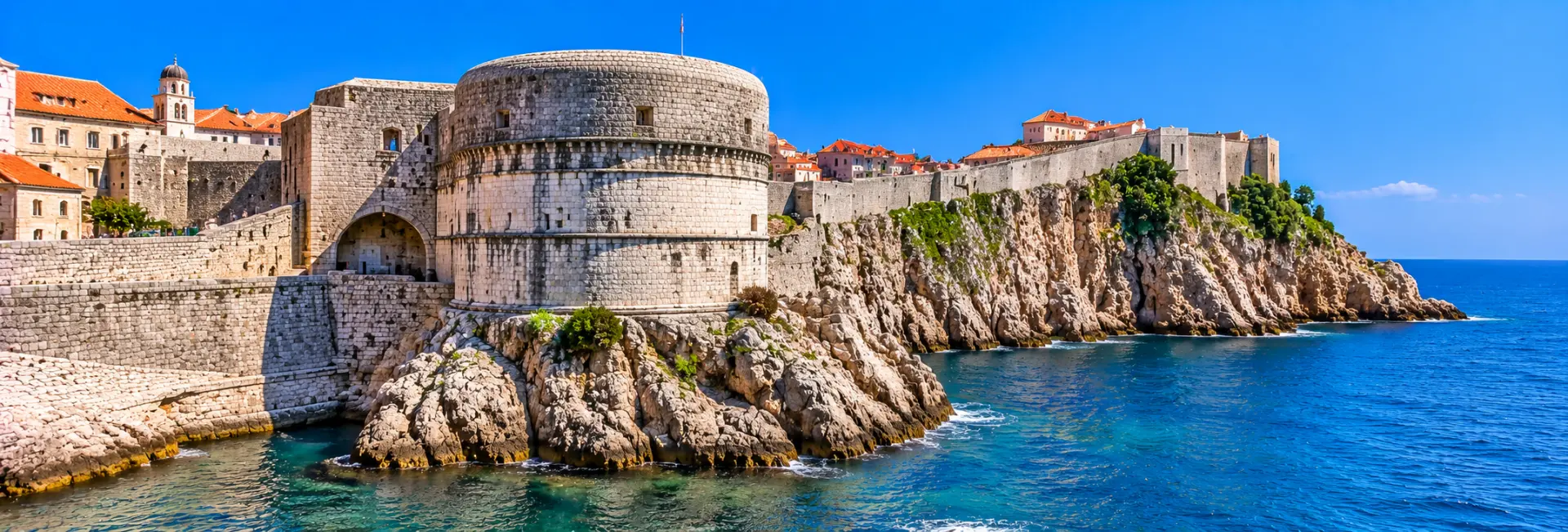
Fort Bokar is the rounded stone bastion that anchors the southwest corner of Dubrovnik's city walls, just south of Pile Gate. Seen from the drawbridge or from the cliffs across the bay, it looks like a solid drum of masonry rising straight from the rocks above the Adriatic.
The fortress was designed in the 15th century by the Florentine architect Michelozzo di Bartolomeo, one of the leading builders of the Italian Renaissance, and it was created to cover the most exposed approach to the city. Its guns commanded the bridge and moat at Pile Gate and the small harbor below, which made it a key part of the republic's defenses.
Today it is one of the most atmospheric stops on a walk around the walls. Visitors come for the wide sea views, the sense of standing inside a real Renaissance gun platform, and the sight of Fort Lovrijenac on its rock across the water. In summer the fort's terraces and rooms also serve as a stage for performances during the Dubrovnik Summer Festival.
The fort is also known by the name Zvjezdan, and it is often counted among the oldest casemated fortresses in Europe, which adds to its appeal for anyone interested in military architecture.
History
A Renaissance answer to new weapons
By the middle of the 15th century, the Republic of Ragusa faced growing pressure from stronger neighbors and from the spread of gunpowder artillery. Medieval walls and square towers were no longer enough, so the city invited Michelozzo, a famous Florentine master, to help modernize its defenses.
Construction in the 1460s
Work on Fort Bokar began in 1461 and the main structure took shape over the following few years, with the building generally dated to 1461-1463. Michelozzo designed it as a two-storey casemate fortress, which means that the guns were placed inside vaulted chambers rather than on an open roof.
Completion in the 16th century
The fort was not finished in one campaign. A vaulted structure was added in the middle of the 16th century, and the fortress was further expanded in 1570, which gave it the form that visitors see today. The long building period shows how seriously, and how carefully, the city approached the project.
Later uses
As the age of sieges passed, the fort found new functions. In the 19th century it served for a time as a prison, and in modern times it has become a cultural venue and a visitor attraction on the city walls.
Recognition
Fort Bokar forms part of the walls of Dubrovnik, which belong to the Old City of Dubrovnik, inscribed on the UNESCO World Heritage List in 1979.
Architecture and Design
A drum of stone
The fort is a semicircular, or rounded, bastion built from thick blocks of local stone. Its curved form was a deliberate military choice, since a round surface deflects cannonballs better than a flat wall and leaves no sharp corners for attackers to target.
Casemates and gun ports
The most important feature of the design is the casemate, a vaulted chamber built to hold artillery. Inside, narrow openings once allowed cannons to fire out across the moat and the bridge while the gunners stayed protected by the masonry around them. A smaller upper tower, pierced with additional gun openings, adds a second level of firepower.
- Thick walls that could absorb artillery fire.
- Vaulted rooms for guns, ammunition and the soldiers who served them.
- An open upper level with long views over the approaches.
Fit with the walls
The fortress is joined directly to the wall circuit, so it works as part of a single system rather than a stand-alone castle. Its position at the corner gives it overlapping views along two sides of the city, with the sea on one side and the land approaches on the other.
Role in Dubrovnik's Defense
Guarding Pile Gate
Pile Gate was the principal entrance to Dubrovnik from the west, and a gate is always a weak point in a city wall. Fort Bokar was positioned to cover it, with fire directed at the bridge and moat in front of the gate so that any attacking force would be exposed as it approached.
Watching the sea
The fort also looked over the small harbor below the western walls and over the approaches from the water. In a siege or landing, its guns could cover the bay and prevent enemy ships from coming close to the shore.
Working with Fort Lovrijenac
Directly across the bay, Fort Lovrijenac stands on a high rock outside the walls. Together the two forts formed a crossfire zone around the western entrance, with each guarding the other and both protecting the gate. Looking from one to the other today, you can easily see how the system was meant to work.
A city that avoided conquest
Dubrovnik's defenses were so formidable that the city kept its independence for centuries, and Fort Bokar was one of the pieces that made this possible. The walls as a whole are about 1,940 meters long and include five forts and sixteen towers and bastions.
What to See and Do
Walk the terraces and gun platforms
Inside the fort you can walk through stone passages, climb to the upper level and look out through the openings that once held cannons. The terrace gives some of the best open views on the western side of the walls.
Look out over the bay
From the top, the view takes in the small harbor and cove below, the cliffs and the open Adriatic. Fort Lovrijenac stands on its rock opposite, and on clear days the sea and the sky seem to merge at the horizon.
The lapidary collection and cannons
Visitors can see a small collection of carved stone fragments from the Dubrovnik area displayed in the fort, along with historic cannons. These give a tangible link to the fort's working life and to the craftsmanship of the city's stonemasons.
Photography
Fort Bokar is one of the most photogenic corners of the walls. The best images of the fort itself are often taken from the drawbridge at Pile Gate or from the battlements of Fort Lovrijenac, where the full round shape rises above the water.
Culture and Screen Appearances
The Dubrovnik Summer Festival
During the summer festival, the fort's open spaces and rooms host theatrical and musical performances. A stage set against ancient stone and the sea is a memorable setting, and it is one of the reasons the fort remains a living part of the city's cultural life rather than a silent monument.
Game of Thrones
Dubrovnik's walls and forts appear in the television series Game of Thrones, and Fort Bokar is among the locations fans look for. The rounded bastion and the stone corridors suit the fantasy setting well, which brings many visitors to the western walls each year.
A symbol of the city
Along with Minčeta Tower, Revelin and Fort Lovrijenac, Fort Bokar is one of the images most closely associated with Dubrovnik. For locals it stands for the city's long defense of its freedom, and for visitors it is a clear lesson in how Renaissance engineers adapted to the age of cannons.
Best Time to Visit
Season
The city walls, which include Fort Bokar, are open throughout the year, although opening hours change with the season. Summer brings the longest hours and warmest weather, but also the biggest crowds and strong sun on the exposed stone. Spring and early autumn offer a better balance of comfortable temperatures and lighter traffic on the walls.
Time of day
- Early morning is the quietest time, with cooler air and soft light on the sea.
- Midday can be hot and busy, and the stone holds the heat, so bring water and sun protection.
- Late afternoon is ideal for golden light on the walls and the view toward the sunset over the Adriatic.
If you plan to attend a festival performance at the fort, check the summer schedule in advance and book ahead, as popular events can sell out.
Visitor Tips
- Fort Bokar is reached as part of the city walls, so you need a city walls ticket. Check the current price and opening hours before you go, as they change by season.
- The wall ticket generally also gives access to the other main forts on the circuit, including Fort Lovrijenac, St John's Fortress and Minčeta Tower. Confirm the details when you buy.
- Enter the walls near the Church of St Saviour just inside Pile Gate, and follow the circuit toward the western section.
- Wear comfortable shoes with good grip, because the stone steps and passages can be uneven and slippery.
- Bring water, a hat and sunscreen, as shade on the walls is limited.
- Go early or late in the day to avoid the largest crowds and the strongest heat.
Time needed
A complete walk around the walls usually takes between one and a half and two hours, and Fort Bokar is one stop along the way. You can spend as little as fifteen minutes at the fort itself, or longer if you want to enjoy the view and the exhibits.
Accessibility
The walls involve many stairs and steep sections, and the fort is not suitable for wheelchair users. Visitors with limited mobility should consider viewing the fort from the Pile Gate area below.
Nearby Attractions
Pile Gate
The main western entrance to the Old Town is just beside the fort. Crossing the bridge and passing through the gate is the classic way to arrive in Dubrovnik, and the stonework and carved statue of the city's patron saint are worth a look.
Fort Lovrijenac
Often called the Gibraltar of Dubrovnik, this fortress stands on a high cliff just outside the walls, a short walk from Fort Bokar. It is also used as a theater during the summer festival, and it offers the best view back toward Fort Bokar.
Franciscan Monastery
Just inside Pile Gate, the monastery has a peaceful cloister and one of the oldest pharmacies in Europe, making a pleasant contrast to the military history of the fort.
Stradun and the Old Town
The limestone-paved main street begins a few steps from the gate and leads to the heart of the Old Town, with churches, palaces, cafes and shops all within easy walking distance.
Minčeta Tower and St John's Fortress
Continuing along the wall circuit, you can reach the other great fortifications of the city, including the highest tower on the walls and the fortress that guards the old harbor.
FAQs about visiting Fort Bokar
What is Fort Bokar? +
It is a round Renaissance fortress at the southwest corner of Dubrovnik's city walls, designed by the Florentine architect Michelozzo and begun in 1461. It was built to defend Pile Gate and the western approaches to the city.
Who built Fort Bokar and when? +
Michelozzo di Bartolomeo designed it, and the main structure dates to the 1460s. The fort was strengthened and extended in the 16th century, with further work recorded in 1555 and 1570.
Do you need a ticket to visit Fort Bokar? +
Yes, the fort is visited as part of the city walls, so a walls ticket is required. Prices and hours change by season, so check the current details before you go.
How long does it take to see Fort Bokar? +
The fort itself needs only fifteen to thirty minutes, but most visitors see it as part of a full walk around the walls, which takes about one and a half to two hours.
What is the best view from Fort Bokar? +
The terrace looks over the small harbor below, the Adriatic Sea and Fort Lovrijenac across the bay. For the best view of Fort Bokar itself, look back at it from the drawbridge at Pile Gate or from Fort Lovrijenac.
Is Fort Bokar a Game of Thrones location? +
Yes, Dubrovnik's walls and forts appear in the series, and Fort Bokar is one of the places fans seek out. Many visitors combine it with other filming locations along the walls.
Is Fort Bokar accessible for wheelchair users? +
No, the fort is reached by stairs and steep wall sections, so it is not wheelchair accessible. Visitors with limited mobility can admire it from the area around Pile Gate instead.
When is the best time to visit Fort Bokar? +
Early morning and late afternoon are the best times, with softer light and fewer people. Spring and autumn are more comfortable than midsummer, when the stone gets very hot.
