
Table of Contents
Overview
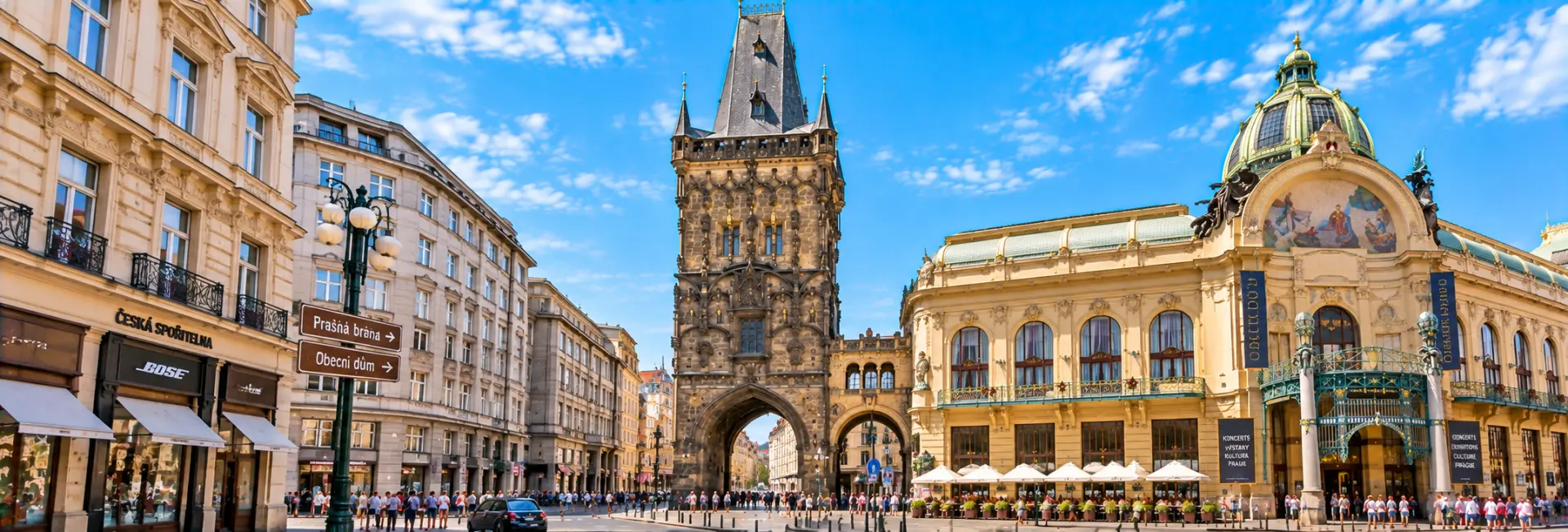
The Powder Tower, known locally as Prašná brána, is a soot-darkened Gothic gate standing on Náměstí Republiky (Republic Square) at the eastern edge of Prague's Old Town. Rising 65 metres above the traffic below, it is one of only two surviving gates from the medieval fortification ring that once encircled the district, and it remains one of the most photographed silhouettes in the city.
Beyond its role as a striking city entrance, the tower marks the starting point of the Royal Route, the ceremonial path Bohemian kings once followed from their coronation to Prague Castle. Visitors today can climb its spiral staircase to a viewing gallery partway up, take in a small history exhibition inside, or simply pass beneath its archway on the way into the Old Town, much as travelers have for more than five centuries.
History
A Coronation Gift Turned Unfinished Gate
The tower that stands today replaces an older, crumbling gate on the same spot, worn down enough that locals nicknamed it "the Scruffy One." In 1475, the Old Town council commissioned a grander replacement as a gift to King Vladislav II, who personally laid the foundation stone. Construction began under builder Wenceslas of Žlutice and continued from 1478 under Matěj Rejsek, the architect also responsible for much of the tower's early sculptural decoration, who modeled the new gate on the older Old Town Bridge Tower nearby.
The project stalled before it was ever finished. When civil unrest pushed Vladislav II to relocate his royal court to Prague Castle in the 1480s, the funding and motivation to complete the gate largely disappeared. The tower was left topped with a plain temporary roof for roughly four centuries, a half-built monument beside the king's now-empty former palace.
Fire, Gunpowder, and a New Name
A fire tore through the structure in 1541, and it was patched up rather than rebuilt from scratch. It wasn't until the late seventeenth century that the tower took on the identity it's known by today: city authorities began storing gunpowder inside its base, and the nickname "Prašná brána," or Powder Gate, stuck long after the gunpowder itself was moved elsewhere for safety. The building also suffered further damage during the Prussian occupation of Prague in 1757.
The Neo-Gothic Restoration
The tower's present ornate appearance dates from a major reconstruction carried out between 1875 and 1886 under architect Josef Mocker, working alongside sculptors including Bohuslav Schnirch and Ludvík Šimek. Mocker completed what medieval builders had abandoned, adding the elaborate stonework, statues, and pointed roof that give the tower its dramatic silhouette today, in a style meant to echo its late-Gothic origins rather than replicate them exactly.
Architecture & Design
The Powder Tower is built from dark sandstone blocks that have weathered to an almost black tone, giving the structure its brooding, fortress-like appearance despite its ceremonial rather than defensive purpose. Its footprint actually sits on the base of an old fortification moat, roughly nine metres below today's street level, though the moat was filled in long ago once the gate lost its defensive role.
Facade Sculpture
The tower's decoration centers on Bohemian royal history. Statues of monarchs including Charles IV, Vladislav II, Ottokar II, and George of Poděbrady occupy niches on the lower facades, each paired with the coat of arms of a territory under their rule. Higher up, figures of saints, angels, and biblical characters such as Adam and Eve surround representations of Christ and the Virgin Mary, blending royal history with religious imagery in a single carved program.
A Contrast in Styles
A covered passage links the tower directly to the neighboring Municipal House, an Art Nouveau concert hall and cultural venue completed in the early twentieth century. The pairing creates one of the sharpest architectural contrasts anywhere in Prague: a dark, spiky medieval gate standing shoulder to shoulder with pale, curving Art Nouveau ornament.
Recognition & Status
The Powder Tower is registered as a national cultural monument of the Czech Republic, a designation reserved for buildings considered central to the country's heritage. It also sits within the Historic Centre of Prague, inscribed as a UNESCO World Heritage Site in 1992, an area that protects the dense concentration of Gothic, Baroque, and later architecture across the Old Town, Lesser Town, and New Town.
Alongside the Lesser Town Bridge Tower at the far end of Charles Bridge, it is one of only two of Prague's original thirteen city gates still standing, making it a rare physical link to the medieval fortifications that once defined the Old Town's boundaries.
What to See There
The Viewing Gallery
A spiral stone staircase of 186 steps leads up through the tower to a viewing gallery set at 44 metres, well below the tower's full 65-metre height but still high enough for sweeping views. Looking one way, the gallery lines up directly with Celetná Street running into the heart of the Old Town; looking the other, visitors can pick out Prague Castle, the spires around Old Town Square, and, depending on the direction, landmarks as far off as Žižkov Tower and Petřín Hill.
Interior Exhibition
Inside, a modest exhibition traces the tower's construction and its place among Prague's original city gates and towers, with historical panels and occasional artifacts illustrating medieval city life. It's a brief stop rather than a full museum visit, but it adds context before or after the climb.
The Ground-Floor Archway
Even visitors who skip the climb pass through the tower's open archway at street level, which functions as a pedestrian passageway into the Old Town and is accessible at any hour, free of charge.
Ways to Experience It
There's no single "right" way to visit the Powder Tower, and most people combine two or three of the following in a single stop:
- Climb the 186 steps to the viewing gallery for a rooftop perspective over the Old Town's rooftops and spires
- Walk through the free ground-floor archway without paying for entry, simply to see the tower up close
- Start the historic Royal Route on foot from the tower, following the same path coronation processions once took toward Prague Castle
- Pair the visit with the adjoining Municipal House, stepping from Gothic stonework into Art Nouveau interiors within a few metres
- Join a walking tour of the Old Town that includes the tower as an early stop, since many guided routes begin near Republic Square
Best Time to Visit
The tower is at its most photogenic in the early morning, when low light rakes across the carved facades and the square below is still relatively quiet. Arriving close to opening time also means shorter waits for the staircase, which is narrow and only comfortably fits one direction of foot traffic at a time.
- Spring and autumn bring milder temperatures for the climb and clearer visibility from the gallery than the hazier summer months
- Summer evenings, near closing time, can offer a warm, golden light over Prague Castle, though results depend on cloud cover
- Winter visits mean shorter opening hours but fewer crowds both inside the tower and on the surrounding square
Visitor Tips
A few practical points make the visit smoother:
- The spiral staircase is steep, narrow, and has no elevator, so it isn't well suited to visitors with mobility difficulties or very young children in strollers
- Opening hours shift by season, running shorter in winter months and extending into the evening during summer, so it's worth checking current hours before arriving
- Standard adult admission is a low, fixed fee, with reduced rates typically offered for the first hour after opening
- The tower sits directly on Náměstí Republiky, a short walk from Old Town Square, Wenceslas Square, and the Náměstí Republiky metro station, making it an easy add-on to a broader walk through the Old Town
- Because a separate, unrelated tower inside the Prague Castle complex also carries the name "Powder Tower," it's worth double-checking that a ticket or tour refers to this one on Republic Square
FAQs about visiting the Powder Tower
What is the Powder Tower? +
It's a 65-metre Gothic gate on Prague's Republic Square, one of the original entrances to the Old Town and the traditional starting point of the Royal Route once used for coronation processions.
Why is it called the Powder Tower? +
City authorities used the tower to store gunpowder from the late seventeenth century onward, and the nickname "Prašná brána," or Powder Gate, outlasted the gunpowder itself by centuries.
How many steps are there to the top? +
There are 186 stone steps up the spiral staircase to the viewing gallery, which sits at 44 metres, short of the tower's full 65-metre height.
Is it worth climbing, or is the exterior enough? +
The exterior alone is worth seeing for its carved statues and contrast with the neighboring Municipal House, but the climb adds a direct view down Celetná Street and across the Old Town's rooftops that isn't visible from ground level.
How long does a visit take? +
Most visitors spend around 30 to 45 minutes, including the climb, a look at the interior exhibition, and time at the top for photos.
Is the Powder Tower free to enter? +
Walking through the ground-floor archway is free at any time, but climbing to the viewing gallery and interior exhibition requires a paid ticket.
Is it accessible for visitors with limited mobility? +
No, the spiral staircase is narrow and steep with no elevator, so the climb isn't practical for wheelchair users, most strollers, or visitors who have difficulty with stairs.
What's nearby? +
The Municipal House sits directly beside it, and Old Town Square, Wenceslas Square, and the Náměstí Republiky metro station are all within a short walk.
Is there another Powder Tower in Prague? +
Yes, a separate and unrelated tower of the same name stands inside the Prague Castle complex, formerly used as an alchemists' workshop, so it's worth confirming which one a ticket refers to.
Is the Powder Tower connected to the Charles Bridge tower? +
Not directly, though both were built as gates into Prague and share a similar Gothic style; the Powder Tower's design was modeled in part on the Old Town Bridge Tower at the opposite end of the Royal Route.
